Showing posts with label History. Show all posts

Friday, July 10, 2015

Spotlight on our Collection: The Golden Casket

Woodrow Wilson was the first U.S. President to travel to Europe while in office. In December 1918, on his way to the Paris Peace Conference at the end of the Great War, the President visited England among other countries. The people of London welcomed the President with tremendous applause. As reported in The Guardian on December 27th, 1918, tens of thousands of Londoners packed the street to see Woodrow Wilson [1].
Woodrow Wilson riding through the streets of London, 1918
The Town Councilors of London thanked the President for protecting the freedom of the City of London during the war and presented to him a golden casket that now resides in the library of the President Woodrow Wilson House.

The Golden Casket
The golden casket, made by Garrard and Co. Ltd., celebrates the union between America and Great Britain as well as victory in war. On either side of the box are the female personifications of America and Great Britain. The front of the box features miniature portraits of King George V and President Woodrow Wilson beneath the flags of each leader’s respective country. Proudly sitting on top of the casket is the coat of arms for the City of London.

This gift from the City of London echoes the importance of Woodrow Wilson and the immense respect he commanded among Europeans for his efforts in the First World War and campaign for peace. During Wilson’s era, America emerged for the first time as a world power. The casket reflects just how predominant the United States and the President had become following the First World War as world leaders, like King George V, started to recognize the United States as an emerging world power.

-Alexandra Lilly

Monday, November 3, 2014

Mrs. Wilson's Travels

           After President Woodrow Wilson’s death in 1924 his wife, Edith Bolling Galt Wilson, remained dedicated to her husband’s work and memory. She personally worked with President Wilson’s biographer and with those responsible for writing the 1944 film, Wilson.[1] Mrs. Wilson was also responsible for preserving her husband’s birthplace in Staunton, Virginia as a museum, and it was Mrs. Wilson who donated their S Street home in Washington, D.C. and its contents to the National Trust for Historic Preservation after her death.[2] However, the former First Lady was not satisfied in protecting her husband’s legacy in the United States, and she often traveled abroad in order to continue her work around the world.
            Mrs. Wilson became familiar with international travel during her husband’s time in office. After World War I, Mrs. Wilson accompanied her husband to Europe while he negotiated the Treaty of Versailles, making her the first current First Lady to travel to Europe.[3] After President Wilson’s death, Mrs. Wilson felt that, in addition to guarding her husband’s historical reputation, it was her duty to travel the world in order to continue the work that he started with the League of Nations.
President and Mrs. Wilson in Paris, Photo from Library of Congress
           In 1929, Mrs. Wilson set off on a world tour, during which she visited China, England, France, and Japan. Her cousin, Rudolph Bolling Teusler, was the head of the St. Luke’s International Hospital in Tokyo at the time, and he came to the United States in order to be with Mrs. Wilson as she traveled from New York to Paris. Teusler’s wife, children, and one of his coworkers from St. Luke’s eventually joined the party in France.[4] Mrs. Wilson made more trips in the 1930’s to new places, such as Egypt, Poland, Germany, and Mexico. Every year, Mrs. Wilson traveled to Geneva, Switzerland, the head quarters of the League of Nations, in order to “observe the workings of the organization her husband has labored so hard to establish.”[5]
            However, while Mrs. Wilson certainly worked to support the League of Nations after her husband’s death, other Americans continued to reject the idea. Many people in congress were afraid that the United States would become a de facto member if they worked too closely with the League of Nations, and Washington therefore avoided working with Geneva whenever possible. Furthermore, the League’s association with the very flawed Treaty of Versailles soon caused the international community to lose faith and confidence in the League of Nations.[6]
President Roosevelt signing the Declaration of War with Japan, Photo from Library of Congress
             However, the idea of an international organization did not disappear. On December 8, 1941, with Mrs. Wilson in the audience, President Franklin D. Roosevelt asked Congress to declare war on the Japanese Empire, bringing the United States into World War II. The war ended a little less than four years later and the American public, by then veterans of two global conflicts, supported the idea of a new organization, which would become the United Nations.


-Sophia Vayansky, Fall 2014 Intern


[1] “First Lady Biography: Edith Wilson,” National First Ladies’ Library.
[2] Caroli, Betty Boyd, “Edith Wilson,” Encyclopedia Britannica.
[3] “First Lady Biography: Edith Wilson,” National First Ladies’ Library.
[4] Streich, Mary, “Edith Wilson & the Orient: 1928, 1932.”
[5] Streich, Mary, “Edith Wilson & the Orient: 1928, 1932.”

Thursday, September 18, 2014

2014 Kalorama House and Embassy Tour


             Last Sunday, those interested in everything from architecture to foreign cultures and everything in between had the opportunity to attend the annual Kalorama House and Embassy Tour, organized by The President Woodrow Wilson House. Visitors had the option to tour six different embassies and a private residence on S Street. They enjoyed refreshments, a jazz ensemble, and an open-house atmosphere at the President Woodrow Wilson House, which is also located on S Street.

Crystal Chandelier, a jazz ensemble, provided live music at the President Woodrow Wilson House on Sunday.

            The Kalorama neighborhood of Washington D.C. was named by Joel Barlow, a poet who moved into the area in 1808. “Kalorama” is Greek for “a beautiful view.” Since the early nineteenth century Kalorama neighborhood was a largely undeveloped, suburban area overlooking downtown D.C., Barlow thought that the name suited the area quite well.[1]
            President Wilson and his wife, Mrs. Edith Wilson, moved into the neighborhood in 1921 after leaving the White House, making the Wilsons the first and only presidential couple to make Washington their permanent residence after leaving office. Their home on S Street, now The President Woodrow Wilson House, was a stately four story mansion that was grand enough to receive guests, but still quiet enough President Wilson could rest, recuperate (he had suffered from a stroke during his second term) and enjoy a peaceful retirement. Waddy Woods built the Wilson house in the Georgian Revival style, one several popular styles of architecture in the neighborhood. Kalorama is also home to examples of Beaux Arts, Mediterranean, and other interesting and beautiful architectural styles.[2] 

 
Guests had the opportunity to enjoy refreshments and music in the back garden at the President Woodrow Wilson House.

            The area continued to develop and urbanize throughout the nineteenth and early twentieth centuries as the streetcar and other transportation systems transformed D.C. into the modern city that it is today. However, it was not until the Great Depression hit the United States 1929 that the beautiful embassies and ambassadorial residences that visitors had the chance to tour last Sunday began to show up in Kalorama. After the stock market crash, many of the area’s wealthier families and homeowners hit hard times and were forced to sell their homes. In many cases, those home were bought by the U.S. government, who transformed the buildings into foreign embassies.[3]

Among the stops on the tour was the Cultural Center at the Korean Embassy. Visitors were able to see beautiful art, try Korean food, wear traditional Korean clothing, and learn about Korean culture.

            The 2014 Kalorama House and Embassy Tour allowed visitors a special chance to explore parts of this beautiful and historic neighborhood that are not generally open to the public. However, the area is always a wonderful place to take a quiet walk and admire the houses and imposing architecture of the modern embassies. Of course, while you are in the area, be sure to visit The President Woodrow Wilson House on S Street!

-Sophia Vayansky


[1]Shilpi Paul, “Kalorama: A Posh View From Embassy Row,” D.C. Urban Turf.
[2]The President Woodrow Wilson House, “Wilson House,” www.woodrowwilsonhouse.org/wilson-house
Shilpi Paul, “Kalorama: A Posh View From Embassy Row,” D.C. Urban Turf
[3] Shilpi Paul, “Kalorama: A Posh View From Embassy Row,” D.C. Urban Turf.

Thursday, June 12, 2014

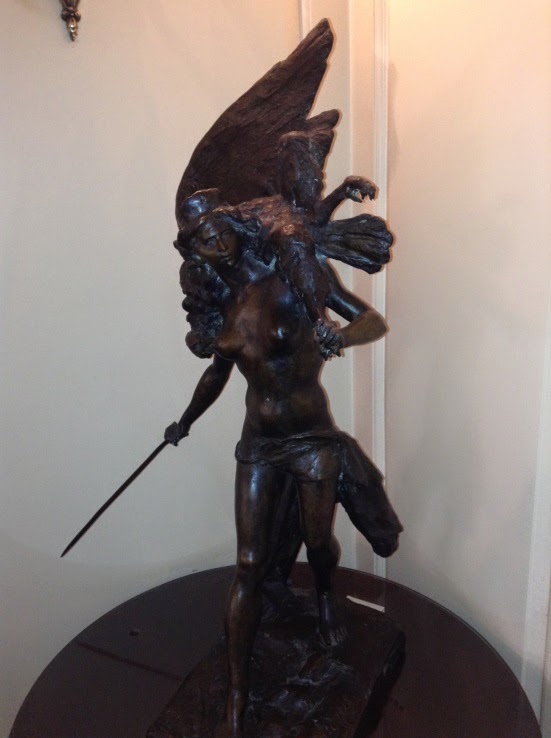
Spotlight on our Collections: Statue of Italy Triumphant

Statue of Italy Triumphant
President Woodrow Wilson House collection
Photo: Winston Randolph
Outside the drawing room on the second floor of the President Woodrow Wilson House stands a statue given by the people of Milan to President Wilson in gratitude of Wilson’s role in World War One. The statue, made from a melted down Austrian artillery piece, depicts a feminine figure, representing either Italia Turrita (an allegory figure of Italy) or the goddess Victory. In one hand she holds a sword while in the other she carries a dead and defeated two headed eagle, the symbol of the Austro-Hungarian Empire. The sculpture stands as a poignant symbol of Italy’s triumph over its longtime rival in World War One.
            Italy’s role in World War One is often less recognized than the roles of France or the British Empire. Prior to the war Italy had been allied to the Central Powers of Germany and Austria-Hungary but remained neutral when hostilities broke out in 1914. In 1915 Italy joined the war on the side of the Allies, fighting Austria-Hungary until the November 1918 peace. The war in Italy did not approach the scale or the cost of the war on other fronts; nevertheless, Italy played a significant role in the Paris Peace Conference.
Wilson in Rome
President Woodrow Wilson House
            President Woodrow and First Lady Edith Wilson received this sculpture in Milan on January 5th. In Italy, Wilson became the first sitting U.S. President to meet with the Pope (Benedict XV). Wilson also used the trip to promote his peace plan, asserting to the Italian parliament that the peacemakers must “organize the friendship of the world, to see to it that all the moral forces that make for right and justice are united and given a vital organization… [to be] substituted for the balance of power.”[1] Similar to other places in Europe, large crowds came out to meet Wilson throughout Italy believing him the deliverer of a new European peace.
1919 while they traveled through Europe before attending the peace conference. Many significant events occurred on Wilson’s trip to Italy.
           
Crowd to see Wilson in Rome
President Woodrow Wilson House Collection
In later years in her home on S Street, Edith Wilson made sure to cover the tip of the statue’s sword with a tennis ball whenever the grandchildren came to visit. Today the statue ushers guests into the formal drawing room of the Wilson House which holds many other state gifts the Wilsons received on their trip to Europe. These gifts, including others received by Wilson in Italy, showcase Wilson’s role as an international diplomat and highlight the scope of his travels before the Paris Peace Conference.


-Winston Randolph


[1]John Milton Cooper, Woodrow Wilson: A Biography page 465

Monday, June 2, 2014

A Decade of Change

The years from 1910 to 1920 were a time of great change for the United States. Led by President Wilson from 1913 till 1921, the nation became a true world power. The country was involved in numerous foreign affairs, from the completion of the Panama Canal in 1914 to entering the Great War in 1917. At home, Americans saw a lot of change in their day to day lives as well.

During the first five years of the decade, 1910-1915, immigrants were entering the US at an average of 900,000 per year. Immigrants were arriving at record breaking numbers; more than 22 million had set foot in America by 1914. All of this changed when WWI broke out in Europe in 1914. From 1915-1919, the number of immigrants entering the United States dropped to an average of only a quarter of a million per annum1. Answering the call of their home nations embroiled in conflict, many immigrants left the US, most of them from eastern cities. Labor shortages resulted from young men enlisting in the war effort and from the lack of immigrant laborers. Other minorities - such as women and African Americans - began to take advantage of the large amounts of work left undone.

  
An African American family moving up north
Source: International African American Museum
Referred to as the Great Migration, millions of African Americans migrated from the southern states to the more industrialized north to answer the call to work. African Americans could expect to earn three times more working in a Northern factory as compared to working in the Southern fields. Between 1910 and 1920, northern industrial cities saw large booms in their African American populations. New York’s African American population experienced an increase of 66%. Chicago’s population grew by 148%. Detroit, the center of the newly invented automobile, grew by 611%2. Many of these new workers took jobs in factories, slaughterhouses, and foundries, or metal casting factories.

An increase in the manufacturing and mechanical industries was not only a result of a greater demand for these services through war efforts but also a result of the changing living and working conditions. The Keating-Own Child Labor Act was signed in 1916, limiting the work hours for children which began a new program of federal regulation in the industry3. Workdays, in general, became shorter. For example, railroad workers, with the help of the Adamson Act in 1916, had an eight-hour workday established. Labor unions also increased in prominence and power with the passing of the Clayton Antitrust Act in 1914. Unfair business practices were clearly defined, and peaceful strikes and picketing were legalized3. 

A Ford car factory in 1917
Source: Library of Congress
The 1910s saw a great change in transportation as well. Americans became captivated by the introduction of automobiles and airplanes. With the introduction of the automobile in 1886 and the Ford Model T in 1908, people were able to travel farther distances at a much faster rate than ever before. In 1910, there were 458,500 registered automobiles in the US4; by 1920, that number had risen to 9.2 million5. The number of public roads increased drastically, from 2,151,570 miles in 1910 to 2,777,687 in 19205. Other industries tied to the automobile also benefitted from its invention. Automobiles became the lifeline of the petroleum industry and one of the chief customers of the steel industry.

With the Wright Brothers’ first flight in 1903, the world was brought into the aerial age. The first commercial flight took place on January 1, 1914. Abram C. Pheil became the first paying passenger as he won a bid to fly for $400. Pheil, along with pilot Tony Jannus, flew from St. Petersburg, Florida to Tampa, Florida on a round trip that lasted less than an hour and half6. Interests in flight continued to take off after the end of WWI. Experienced fighter pilots were eager to come home and show America their newly developed skills. Air shows sprang up around the country, as pilots competed for awards in distance, speed, and acrobatic stunts7. 

Claude Grahame-White was the first to fly over
our nation's capital on October 14, 1910.
Source: Library of Congress 

Wilson’s presidency was a landmark time that highlights a period when the United States was coming into the modern era. People were starting to realize their rights and to fight for them. New inventions changed the way the old methods of communication and transportation. Many of this decade’s events, including the Great War, would pave the way for future leaders.

2 Great Migration, History Channel 
5 1920s, Federal Reserve Archive [PDF]
6 The First Commercial Flight, FirstFlight Centennial
7 The Aerial Age Begins, Smithsonian National Air and Space Museum 


-Catherine Yuan

Tuesday, May 20, 2014

Propaganda Posters of WWI

When President Wilson ran for his second term, his campaign slogan was “He Kept Us Out of War.” He shared the same sentiment as most Americans at that time, which was one of American neutrality. But with the Germans continued use of unrestricted submarine warfare and the sinking of the American liner Housatonic in February 1917, public outcry against Germany convinced Wilson to ask for a declaration of war on April 2, 1917.

Uncle Sam was a key figure used throughout the
war campaign.
Once in the war, Wilson led a war-mobilization effort across the nation. The Selective Service Act was enacted in May 1917, requiring men between the ages of 21 and 35 to register for the draft. The government also gained control over the railroad industry to prevent strikes and work stoppages. In an effort to increase morale for the war, Wilson created the Committee on Public Information and appointed George Creel, an outspoken supporter of Wilson during both his elections in 1912 and 1916, as its leader. The committee’s strategy was to utilize all aspects of media, including film, art and posters, to address all parts of society to help ensure the full backing of the US war effort. 

The army was a place for men to learn skills
and to better themselves.
For young men, the committee called upon their patriotic spirit to enlist in the army. The use of American icons, such as Uncle Sam, gave them the message that joining the army was a duty to the country. Posters also showed the military as a place to better educate and prepare men with trade skills. Men would not only be doing a service to their country but also a service to themselves. Propaganda techniques like these can still be seen in military recruitment advertisements today.

The government borrowed money from Americans
through the sale of liberty bonds.
An American Red Cross nurse was also
called "our greatest mother."


On the homefront, the Committee of Public Information used posters to persuade women and other members of the public to help out in any way possible. War bonds were cleverly nicknamed liberty bonds in hopes of raising sentiments of freedom and hope. Representatives from the committee, called four-minute men, traveled cross country to give public speeches urging Americans at home to help fund the war. While the men were overseas, women were recruited to join the American Red Cross and become nurses. Nursing offered women the opportunity to work outside of the home and directly with the war.

President Wilson had said that
gardening was "just as real and patriotic
an effort as the building of ships
or the firing of cannon."

Diets were also a part of life that changed.
Certain foods, such as wheat, were conserved
to be sent overseas. 

In an effort to include all Americans, efforts were also used to call upon the services of young children. They were encouraged to join the United States School Garden Army as they were seen as the “soldiers of the soil”. Gardening efforts also helped increase the food supply available for both the homefront and overseas. Posters even appealed to the littlest of Americans by asking them to change their diets to include corn cereals instead of wheat. By presenting simple tasks like these, the committee made it seem that joining the war effort was easy.

President Wilson and the Committee on Public Information were tasked with the job of uniting a country made primarily of immigrants with differing opinions of the war. Through government legislation and the use of propaganda, Wilson and the committee were able to muster enough support to turn the war in favor of the Allies. A year after the US entered the war, Germany surrendered in November 1918.   


All posters images are from the online site: UNC School of Education. 

-Catherine Yuan

Tuesday, May 6, 2014

Mother's Day Centennial


Anna Jarvis, the founder of Mother's Day
Credit: Wikipedia
This year, Mother’s Day celebrates its centennial anniversary! Mother’s Day became a national holiday on May 9, 1914 when President Woodrow Wilson issued a proclamation establishing the second Sunday in May as a day to honor the hard work and dedication of mothers. The campaign for Mother’s Day started in the early 1900s by a woman named Anna Jarvis in West Virginia.

Jarvis advocated for a holiday honoring the sacrifices that mothers make every day for their children. She argued that many of the American holidays at that time were biased toward male achievements. In 1908, five years after her own mother’s death, Jarvis organized a memorial ceremony at a Methodist church in Grafton, West Virginia, to honor not only her mother but also all mothers present. Jarvis also started a letter writing campaign to newspapers and prominent politicians, including Teddy Roosevelt and William Taft, urging them to adopt the holiday. With the help of the World’s Sunday School Association, a key influencer for Jarvis’ cause among legislatures and Congress, 46 states observed the holiday by 1909.


A Mother's Day card from the 1920s
Credit: Hallmark
Legislative action for Mother’s Day was initiated by Elmer Burkett, a senator from Nebraska, in 1908. At the request of the YMCA, Burkett presented the first bill that proposed the national holiday in the US Senate. In 1914, Congress passed a joint resolution designating the second Sunday of May as the national observance of Mother’s Day. Wilson signed the bill into law, proclaiming the day “as a public expression of love and reverence for the mothers of our country.” He selected May 9th, 1914, to be the first national Mother’s Day, as it was the anniversary of Jarvis’ mother’s death.


Janet "Jessie" Woodrow Wilson
Wilson was very fond his mother, Janet “Jessie” Woodrow Wilson. She was born on December 20, 1826 in Carlisle, England, and her family moved to the US when she was five years old. Unfortunately, her own mother passed away while traveling across the Atlantic. The family eventually settled in Ohio, where Jessie was raised by her aunt. Jessie’s father later remarried and began to distance himself from his first family. Jessie married Woodrow’s father, Joseph Wilson, in 1849. The couple had two daughters before Wilson was born in 1856. Many people say Wilson inherited his mother’s long jaw, angular features, and blue-gray eyes. He often called himself a “mama’s boy” and stated in a letter to his first wife Ellen that “the best of womanhood came to me through those apron strings.” Jessie passed away on April 15th, 1888 in Clarksville, Montgomery, Tennessee. The future president was deeply affected by her death: “Her loss has left me with a sad, oppressive sense of having somehow suddenly lost my youth. I feel old and responsibility-ridden.”


What are you doing this year to celebrate the mothers in your life? Come join the President Woodrow Wilson House for our Mother’s Day Centennial Luncheon at the Willard Intercontinental! Tickets are available here! 

-Catherine Yuan

Wednesday, April 30, 2014

Lawn Games

A view of the President Woodrow Wilson House garden
As the weather starts to warm 
up for spring, The President Woodrow Wilson House is starting to move outdoors and into our garden! Historically,
lawn games were a popular outdoor recreational activity for families in the middle class 
during the 1910s. Many games were introduced to the American lifestyle by immigrants from Europe, specifically England 
and Scotland. With the invention of the lawn mower in 1830, people began to look for games that required a short mown lawn for play. By the 1900s, white-collar workers and professionals had the time and money to spend on leisurely pursuits. They favored the idea that, in sports, the best player was based on skill rather than social advantages. For the first time this year, the Woodrow Wilson House will be opening up our garden for lawn games at Vintage Game Night! Check out these featured games below:

Croquet gave women the chance to play outdoors with the
company of men, Credit: Library of Congress 
Croquet - Introduced to the United States in the early 1870s, croquet quickly became a staple for outdoor recreation as it was not only played in private backyards but also in public parks.  The game was often seen at garden parties, outdoor social events and fundraisers, and family gatherings. Popular with both men and women, croquet was the first game played by both sexes and still continues to be the only sport where handicap rules are the same for both. The game is played by hitting balls through a series of hoops that have been set in a predetermined pattern. The winner of the game is the first player or team to complete their sequence of hoops and to hit the center peg.


The US Lawn Bowling Association was established in 1915
Credit: Library of Congress
Lawn bowling - The history of lawn bowling can be traced all the way back to the ancient Egyptians, but it was first played in the United States in the early 1600s. There are even records that show President George Washington playing this lawn game at his estate. Many of the present day rules and code of laws were developed in Scotland, where it is now one of the most popular games to play besides golf.  Lawn bowling is played by two teams ranging from two players to four players each. The teams alternate in turn as players bowl their ball down the area of play. The winner of the game is the team that has the closest bowl to the jack, which is a white round ball that is the first to be bowled by the leader. 


Vintage Game Nights are held the first
Wednesday of every month! 
Our next Vintage Game Night is on May 7th from 5:30pm to 8pm. In addition to croquet and lawn bowling, guests can also play card games and vintage board games. Tickets are $15 which includes entrance to the museum, 2 drink vouchers, gaming munchies, and all-you-can-play vintage board games; they can be ordered here. We hope to see you there!


-Catherine Yuan

Friday, February 7, 2014

Would Wilson Condone Speakeasies?

The Speakeasy Bash, a fun event inviting the public of the year 2014 to take a step back into history and learn about the Prohibition era, is taking place at The President Woodrow Wilson House Thursday, February 13, 2014.  Our 28th President Woodrow Wilson opposed the 18th Amendment and the Volstead Act, which created Prohibition and went into effect in 1920. Specifically, the amendment prohibited the manufacturing, transportation and sale of alcohol in the United States of America.  Wilson vetoed the Volstead Act claiming that the act was unenforceable, but the veto was overridden by Congress in the next day.

Wilson left office after two terms as President in 1921 and moved to his home on 2340 S St NW in Washington, DC. He received special permission from Congress to transport his wine along with the rest of his belongings from the White House to his new private residence.  Wilson’s presidential successor was Warren Harding, who transported alcohol into the White House without permission.  This shows that Wilson could have gotten away with transporting alcohol, but that upholding the integrity of the government and following the rules was important to him even though he did not necessarily agree with them.

Dancing in a jazz club, Credit: Wikipedia
Where was the integrity of the country during this time?  Long gone.  People found many ways to ignore the new laws and go about their drinking.  The upper classes were less affected by prohibition that the lower classes, as the wealthy often had their own wine cellars in place before the beginning of prohibition and had more money to pay off people who could get them illegal alcohol.  There was more opportunity for them to drink under the radar.

Still, the excitement of opposing prohibition was enjoyed by most across the nation, no matter the social class.  The lower-class establishments were commonly called ‘blind tigers’ or ‘blind pigs’, while the high-class establishments that we romanticize today became known as…you guessed it…’speakeasies’. These establishments provided a place for people to drink, dance, and escape the hard times of their lives, as well as allowing them a place to flirt with danger.  The defiance of society at the time became the part of the culture we today call iconic.

Costumed guests at the Speakeasy Bash!
What would Woodrow Wilson say about having a speakeasy at his house?  We know he was against prohibition, but we also know he followed the government’s rules.   Let us know what you think Wilson would have said in the comments below, and make sure to pick up your tickets for the Speakeasy Bash here!

-Bethany Hagen